



Recent Posts
Popular Categories
Contributors
 Partner
 Partner
 Special Counsel
Archives
When I was asked to contribute to this edition of Views and Visions, focusing on entrepreneurship, my first thought was I should learn how to spell it. I misspelled it the first couple of times I tried and then had to rely on spellcheck, praise the Lord!
My 27-year journey of being an entrepreneur, if that’s what you want to call it, began in 1999. My recollection of that summer and early fall is that they were similar to many others, relatively nondescript. I had no idea when my company was born that I was becoming an entrepreneur. It was much simpler, much more basic—I needed to make a living to support my family.
I have worked in the construction industry in one form or another since graduating from West Virginia University Institute of Technology (WVU Tech) in spring 1984. First, I worked as a “flunky” for a very small architectural firm in Huntington, making the whopping sum of $5.10 per hour. To find a “real” job, I, like many of my WVU Tech classmates, had to move out of state. Reaganomics had yet to take hold, at least in West Virginia, and I was not one of the lucky two out of more than 20 civil engineering graduates who landed jobs right away. This is quite a contrast to what is happening with WVU Tech civil engineering and construction management graduates today.
In February 1985, I moved to the suburbs of Washington, D.C., and went to work for the Naval Facilities Engineering Command. After four years with the government, the opportunity and lure of private industry came calling.
In 1989, I started work as a project manager for a midsized general contractor, also known as a “beltway bandit.” Jowett, Inc. was transitioning from its second generation of family ownership to the third. The company only took on government work with no private projects. My job was a substantial renovation to the Freer Gallery of Art, in downtown Washington, D.C., home of the renowned Peacock Room by James McNeill Whistler. We spent 18 months and several million dollars turning thousands of square feet of existing crawl space into a full-size, fully functional lower level that could house priceless works of art.
The challenge of working for a contractor that relies entirely on government work is that it is vulnerable to the ups and downs of public spending. By 1990, once Reaganomics was in full glory and the iron curtain was falling, government military construction spending, known as MilCon, essentially stopped. Jowett went from $30 million in revenue to $6 million—that was not good for anyone and certainly not the new kid. The day I was laid off, I also learned I had passed the Professional Engineering exam. I’ve often said that was God tempering the devastation.
Another positive was that back in West Virginia, the economy had picked up, and after three months of unemployment, I was able to land a job with a small-to-midsized contractor. Fast forward nine years, three small kids, and one disagreement later, I found entrepreneurship at my front door.
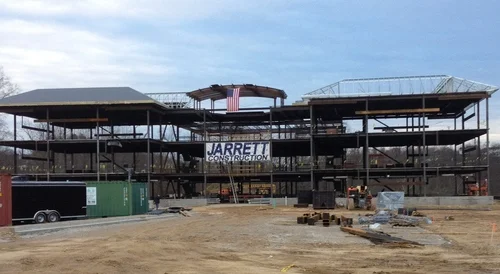
I had long dreamed of running my own company, of figuring out how to deliver the best construction services. When Jarrett Construction started, we—I use that word generously, because at the time it was my wife, Susan; our three young children; and me—had $500 in our bank account and an $80,000 mortgage. My office was my son’s converted 8-by-10-foot bedroom. None of that mattered. The utility companies didn’t care nor did the grocery store. There were diapers, formula, school clothes, and all the other necessities that still kept going and still had to be paid for.
According to Perplexity, the one-sentence definition of entrepreneurship is the act of starting and building a business or venture by identifying opportunities, taking risks, and creating value. I agree. In my case, though, the opportunity was necessity. I needed to provide for my family.
I’ve often heard contractors and gamblers are one and the same. Few, if any, other professions take on as much risk for the reward. Unforeseen underground springs, landslides, owners that go bankrupt or refuse to pay, material and equipment delivery delays, extreme weather, and the like are all enough to make anyone pull their hair out. It’s my job to manage that risk, and I do so by surrounding myself with great teammates, brilliant consultants and counselors, and other good people that do what they say they are going to do.
I also recognize that continuous learning and improvement is mandatory and not just for me—it must be for our entire team. Staying abreast of contract terms, industry innovations, and insurance nuances barely scratches the surface of what is required to give your team an advantage over the competition and help build value for your clients.
With all this being said, I believe it is a wonderful time to be in construction in West Virginia. Business and industry investments like Nucor, TIMET, and Service Wire committing to Almost Heaven will pay dividends for years to come. Thousands of construction jobs have been added over the last 24 months, and hundreds of permanent jobs are coming online. I am confident if our legislature and executive branches focus on jobs, they can lead us to a level of prosperity, unlike anything I have seen in my working career.
So, here’s to all the entrepreneurs out there, whether you know how to spell it or not. Keep the passion, the grit, and the determination to succeed.
 John Jarrett is president of Jarrett Construction Services, Inc. With nearly 30 years of experience, Jarrett brings substantial expertise to any construction project. He is a registered Professional Engineer in West Virginia and Virginia. Jarrett is a member of the Kanawha Valley Historical and Preservation Society. His firm supports the Boy Scouts of America, YWCA of Charleston, Latin American Children’s Fund, and other charitable organizations.